Prince Philip died in April 2021, and his will was sealed for 90 years. The earliest anyone could look at it again is around 2111, and even then a judge decides in private whether the public gets to see it. [1]
That isn’t the only door that stays shut. Some correspondence between government departments and the King can be withheld from Freedom of Information requests without anyone weighing that against the public interest. And the reigning monarch can’t be taken to court the way anyone else can. I wanted to know who decided all that, and why.
Each of those rules has its own logic. Together, they decide how much of the monarchy the rest of us are allowed to see.
The Locks on the Doors
Royal wills: a different set of rules
If someone in your family or mine dies in England or Wales and probate is granted, their will becomes a public record. Anyone can request a copy for a small fee and read it. Normally, a will stays private only if there has been no grant of probate. [2]
Some senior royals get a different rule, by order of the courts.
In September 2021, the High Court ordered that Prince Philip’s will be kept off the public probate record for 90 years, to protect the privacy and dignity of the Sovereign and senior members of the Royal Family. [3] [1]
Dignity is an interesting word to use here, isn’t it? It makes me wonder what dignity would be lost if we knew what was in that will. The judge’s answer was that the public had no real interest in the will’s private contents, only curiosity, and that the media’s interest was commercial. [1] Maybe so. But it’s a strange kind of dignity that has to be protected from the people paying for it.
The hearing was held in private, and the press weren’t told it was happening. The Guardian challenged that. In July 2022 the Court of Appeal dismissed its appeal, accepting these were exceptional circumstances under the probate rules, while still stressing how much open justice matters. [4]
So nobody can say this was done behind the courts’ backs. A judge heard it, and appeal judges backed him. That’s what bothers me most. The secrecy wasn’t a loophole. It was the system working exactly as designed.

The 90 years run from the grant of probate, not from the day the person dies. Even then, the President of the Family Division opens the will in private, with the Sovereign’s private solicitor, the Keeper of the Royal Archives and the Attorney General among those involved, and the court decides whether to release it or seal it again. [5]
So even after 90 years, we might still never see it. Has anyone actually seen one of these wills opened?
A few, yes. In June 2024 the judiciary announced that nine older royal wills had been unsealed, including those of Prince Francis of Teck and Princess Louise, Princess Royal, with copies available through the Probate Registry. [3]
The monarch’s own will is different again. It doesn’t need probate at all, so it never goes before the court and no copy is filed for anyone to inspect, sealed or otherwise. [6] Elizabeth II’s will has not been made public, and there is no court process that would ever release it. [7]
Not in 90 years. Not ever. Your will and mine end up as public records. The will of the woman who headed the state for seventy years is the one nobody gets to read. When a family’s inheritance is bound up with a public institution, I think the public deserves to see more, not less.
Freedom of Information: for thee, but not for me
In theory, the Freedom of Information Act 2000 lets any of us ask a government department for its records. Anyone can ask, and you don’t have to say why.
The exception, of course, is the Royal Household. You can’t send it a request at all, because neither the Household nor the Royal Family counts as a public authority under the Act. You can ask a government department for any records it holds about royal matters. Whether you get them is another question. [8]
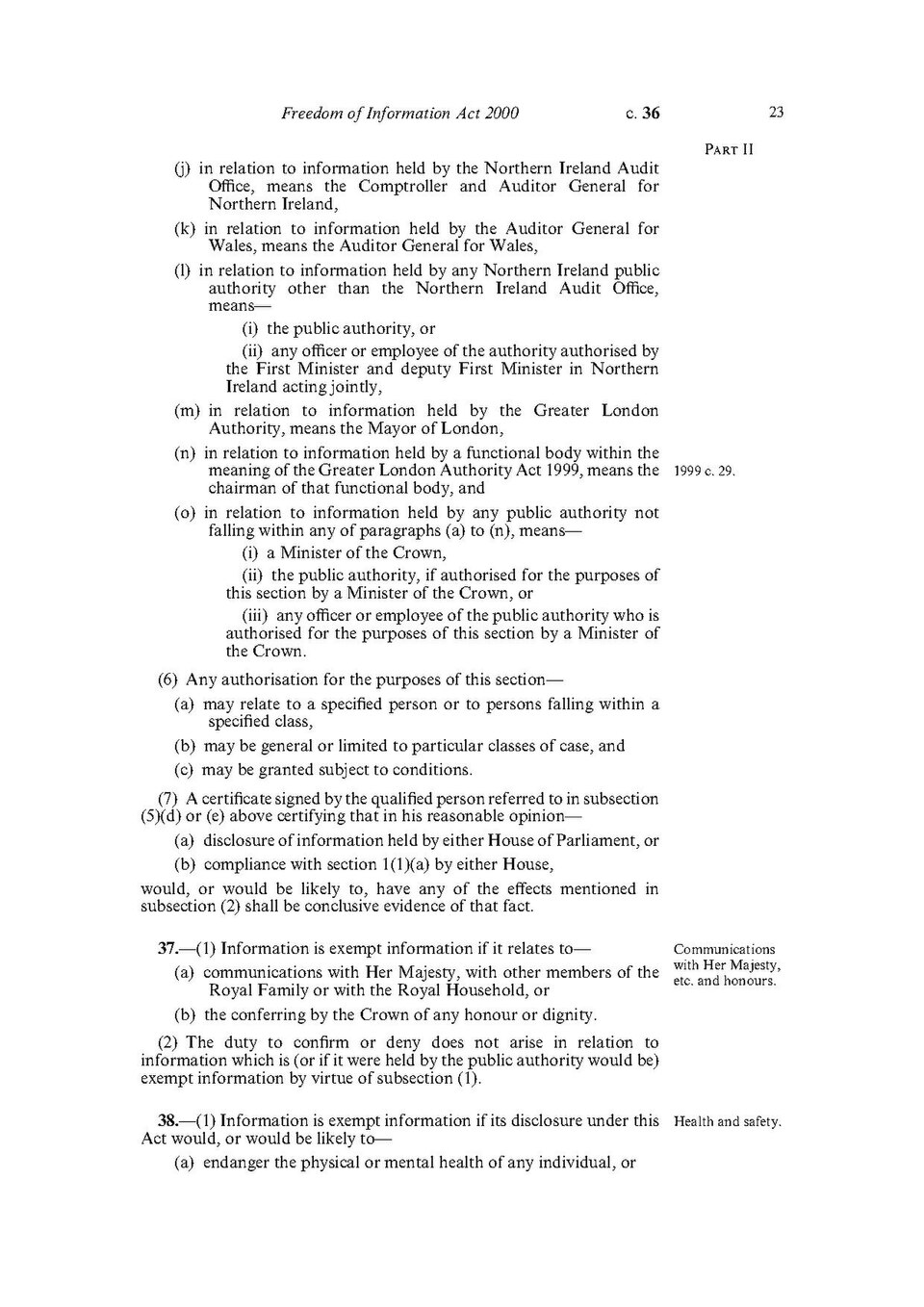
Section 37 covers communications with the monarch, the heir and the person second in line, including anything sent or received on their behalf. For them, the exemption is absolute. A department doesn’t have to weigh the public interest in disclosure before withholding the information, and in some cases it can refuse to confirm whether it holds the records at all. [9] [10]
So you can ask, and you can complain if you’re refused. But the only question anyone will consider is whether the letter falls under section 37. Whether the public ought to see it never comes into it.
It wasn’t always this way. Until 2010, those communications were subject to a public-interest test. The Constitutional Reform and Governance Act removed it, and extended the protection to anyone who later becomes monarch, heir or second in line. [11]
The best-known case shows what that change protects. The Guardian spent ten years trying to see letters Charles, then Prince of Wales, had written to government ministers. A tribunal ordered their release, the Attorney General vetoed it, and in March 2015 the Supreme Court ruled by five to two that the veto was invalid. [12] [13] The 27 items were published that May. Ten were Charles’s own letters, nicknamed the “black spider” memos after his handwriting, and they showed him writing directly to ministers, including the Prime Minister, about government policy. The rest were replies and other correspondence. [14] [15]
So what was he writing about? In 2004, with British troops in Iraq, he wrote to Tony Blair about Lynx helicopters performing badly in high temperatures and delays to their replacement. He warned: “I fear that this is just one more example of where our Armed Forces are being asked to do an extremely challenging job (particularly in Iraq) without the necessary resources.” [16] He pressed Blair on badgers too: “I do urge you to look again at introducing a proper cull of badgers where it is necessary.” [17] Other letters covered farming, illegal fishing and school food. [15]
Some of those concerns were fair ones. What unsettles me is the access. We’re told Parliament is sovereign, and that the people we elect are there to act for us. Yet here was the heir to the throne, now our supposedly neutral King, writing privately to the Prime Minister to press his views on government policy. Most of us will never get that kind of hearing. And we only know it happened because the Guardian fought for years to see the letters under the old rules. Letters like those, from the King or from William as heir, can now be withheld outright. [11]
So where do the rest of us fit in?
Communications involving other members of the Royal Family or the Royal Household have a qualified exemption, so the department must weigh whether the public interest in keeping them private outweighs the public interest in releasing them. [9]
The protection does run out eventually, but not after a simple 20 years. Section 37’s royal exemptions end at the later of 20 years from the record’s creation or five years after the relevant person’s death. So a letter involving someone still alive stays protected for as long as they live, and for five years after, however old it is. Other exemptions may still apply even then. [9]
I can see a fair reason for protecting confidential exchanges between a constitutional monarch and ministers. The King is meant to stay politically neutral, and candid advice can depend on privacy. But for the most senior royals, Parliament decided a department needn’t even ask whether the public interest favours disclosure. That doesn’t mean improper pressure has been applied. It means the records that could show whether it has are legally out of reach.
Sovereign immunity: the one person you can’t take to court
In law, the King as a person and the Crown as the government aren’t the same thing.
In June 2016 a government minister confirmed to Parliament that ordinary civil and criminal proceedings can’t be brought against the reigning Sovereign personally. [18] [19]
If you or I break the law, we can be prosecuted. If we owe someone money, they can take us to court to get it back. The King, on the other hand, can’t be prosecuted or sued at all. That protection belongs to whoever sits on the throne at the time, not to the rest of the Royal Family, who can be taken to court like anyone else. [18]
The Government is a different matter, though that took a long time. Before 1947, suing the state was hard. Many claims needed the monarch’s permission first, and some couldn’t be brought at all. The Crown Proceedings Act 1947 changed that, letting people bring civil claims against the Crown as government in the ordinary way. It’s a big part of why government departments can be held to account in court today. [20] [19]
But section 40 of the same Act preserves the monarch’s private position. The Act doesn’t apply to proceedings involving the Sovereign in a private capacity, and doesn’t authorise claims for civil wrongs against them. The 1947 reform opened a route to suing the state, but not to suing the King personally. [20]
So if you had a genuine grievance against Charles himself, over a private estate, a debt or a wrong done to you, you couldn’t bring an ordinary personal claim against the reigning monarch. There may be other parties you can pursue, but that doesn’t remove his personal immunity.
Even claims against the Government come with special rules. In these Crown proceedings, the court generally cannot grant an injunction or order specific performance. It may instead declare the parties’ rights. Damages can still be awarded where appropriate. [21] Having the right to take the Government to court and getting every remedy you’d have against someone else are two different things.
The Duchies fall on the King’s private side of the 1947 Act. Section 38(3) of the 1947 Act counts the Duchy of Lancaster, and the Duke of Cornwall, as part of the monarch’s private capacity, a point the Supreme Court noted in December 2025 in an unrelated case about a Scottish sheriff. [22]
That doesn’t put them beyond the law. They’re landlords, and their property disputes can still end up before a judge. But it does mean the ordinary route for suing the Government doesn’t apply to them. Add that to the tax treatment in Parts Two and Three, and a pattern emerges. Wherever the rules for everyone else would bite, these estates seem to sit just outside them.
None of this suggests Charles has committed an offence, or that officials acting in the King’s name share his personal immunity. And Parliament can change the framework whenever it chooses. [19] The question is whether the person holding a public office should be shielded from legal proceedings an ordinary citizen would have to answer.
How far should royal privacy extend?
I’ll grant that each of these rules has its reasons. Privacy, neutrality and security are real concerns, and none of these protections proves anyone has done wrong. But a rule being old isn’t a reason to stop asking about it. Put together, they leave us with fewer ways to examine the head of state than we have for any minister or civil servant.
And when you can’t look, you have to rely on someone else finding out. Part Five examines financial privileges written into law and the King’s Consent procedure, which gives the Palace advance sight of certain bills affecting royal interests. [23] It also follows the offshore investments nobody outside knew about until the papers leaked.