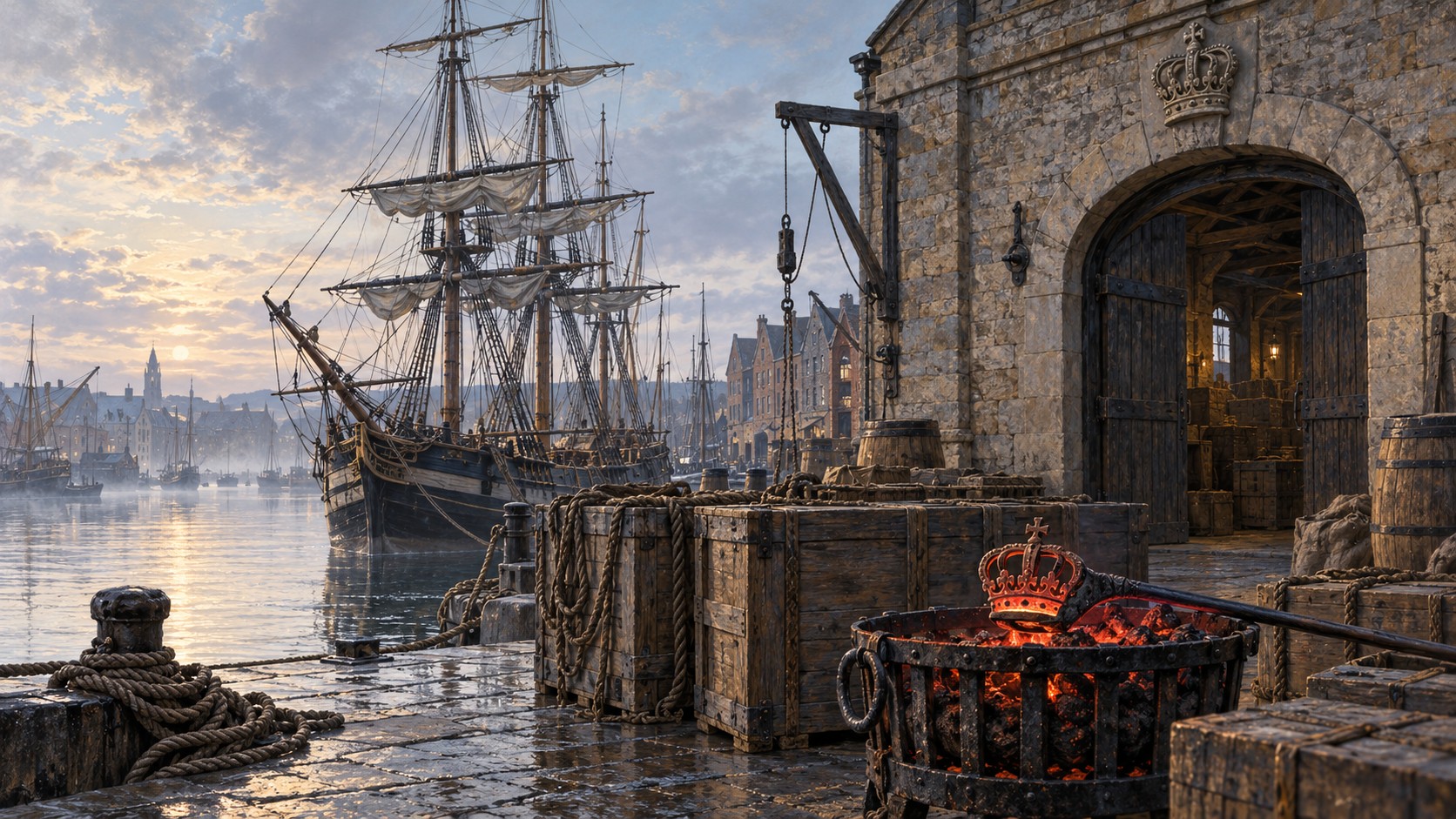
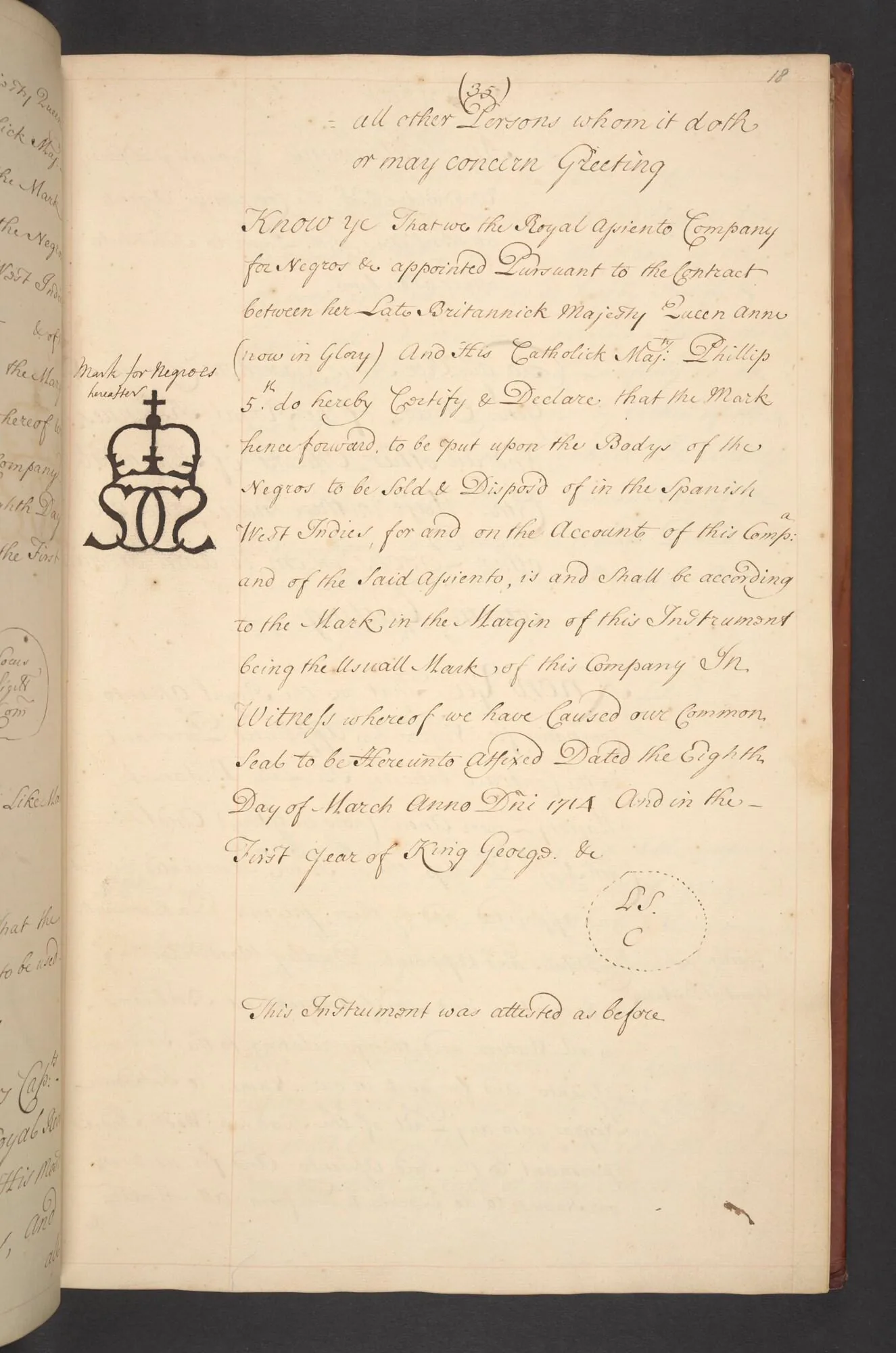
In 1715, the South Sea Company recorded a mark in one of its documents. Above the company’s intertwined initials sat a crown, the symbol of the monarchy.
The mark was meant to be burned into the skin of enslaved Africans sold in the Spanish West Indies. Historian Nicholas Radburn found the document in the British Library. [1] I’ve seen a lot of archive material researching this series. Nothing stopped me in my tracks quite like seeing this.
It also made me think about what we’re taught. In England’s national curriculum for maintained schools, the Holocaust is required at Key Stage 3. Britain’s transatlantic slave trade, by contrast, appears only as a non-statutory example. [2] Why isn’t that history compulsory too? It’s uncomfortable history, not least for institutions that profited from it.
A separate set of letters, from 1714, shows the company’s directors telling their agents to carry out the branding even though a doctor had warned that the large mark could injure the people it was burned into. [3]
That’s a special kind of evil. They were warned it could injure the very people they counted as their “property”, and I hate even typing that word. They went ahead anyway. Not even the money, it seems, mattered more than marking them as owned.
The South Sea Company traded under the slave-trading agreement Britain negotiated with Spain under Queen Anne, and its links to the throne were direct. The Prince of Wales, the future George II, was elected its governor in February 1715, the year the crowned mark was recorded. In 1718 the King himself, George I, took over. [4] [5]
Read that again. A company governed by the heir to the throne, and then by the King himself, trafficked people taken from Africa, branded them with a crown and sold them in Spain’s American colonies.
The documents don’t show a monarch personally ordering the branding. They do show that the South Sea Company instructed its agents to brand enslaved people, and that the crowned mark was recorded weeks after the Prince of Wales became its governor.
Maybe there was never a signed order from him. But he was the company’s governor when that mark was written down. What did he know about what his company was burning into people, and what did he do to stop it? The surviving document doesn’t answer either question.
In September 2026, Lancaster University published research behind the Register of British Slave Traders, documenting thousands of people who financed Britain’s trade in enslaved Africans, members of the royal family among them. [6]
The records of how the Crown became tied to these businesses survive: the charters, commercial privileges and military powers that helped build Britain’s empire.
And still no formal apology for these historic wrongs. Speaking about British colonial abuses in Kenya in October 2023, King Charles expressed his “greatest sorrow and deepest regret”, but stopped short of a formal apology. [7] Kenya isn’t the slave trade, but sorrow isn’t an apology there either. I’ll be honest: writing this makes me angry. What angers me more is watching ordinary people line up to defend the ones who profited. That’s a conversation for another day, and it’s coming.
Colonial Conquest
India: when a company became an empire
On 31 December 1600, Elizabeth I granted a royal charter to the East India Company, giving a group of merchants exclusive trading rights across a vast region for 15 years. The British Library still holds a contemporary transcript. The charter authorised trade, not conquest. [8]
It wasn’t a royal company in the sense of being owned by the monarch. It belonged to its shareholders. But the Crown gave it its powers and kept extending them. And one of the things it took still sits in the Crown Jewels today.
Over the next two centuries the company grew into something far bigger. It built trading settlements, fought wars, acquired territory and collected taxes, governing huge populations while its owners and investors stayed in Britain. Parliament stepped in gradually, including through a government Board of Control. [9]
After the Indian uprising of 1857, the Government of India Act 1858 transferred the company’s governing powers, territories and armed forces to the Crown, turning commercial rule into direct imperial government. [9] The company itself lasted until 1874, but not as a ruler. Since 1833 its shareholders had been guaranteed a dividend of 10.5% a year, paid from what Indians were made to pay in rent and tax, and that carried on until Parliament bought them out and wound the company up. [10] [11] Even after losing India, the company’s investors were still being paid from it. In 1833, the same year that guarantee began, Parliament also voted to compensate slave owners. As the historian Alan Lester points out, both deals protected British property.
Think about that. A private company went in to trade, ended up conquering much of a subcontinent, and taxed the people it had conquered. When it got too big and too bloody to ignore, the Crown didn’t hand India back. It took the lot and ruled it in the monarch’s name.
That history was about money as much as armies and flags. Economist Utsa Patnaik calculated that Britain drained wealth from India between 1765 and 1938 worth about $45 trillion, by measuring India’s export surpluses and compounding the estimated transfers at 5% to 2016. It’s an estimate built on its assumptions, not a bill or a measure of today’s royal fortune, and scholars debate the method. [12] [13] But the history of taxation, trade privileges and wealth leaving India doesn’t depend on accepting the number.
Behind those numbers were people. In 1770, under Company rule, famine swept Bengal. The Company’s own directors estimated that a third of the population had died, around ten million people. Historians now think that figure was inflated, and estimates run from about a million upwards. [14] Yet the Company continued to enforce land-revenue collection while people starved. Historian Om Prakash records that more revenue was collected at the height of the famine than in the following year. [15]
A century later, under the Crown, came the Great Famine of 1876 to 1878. Somewhere between 5.6 and 9.6 million people died. [14] Under Viceroy Lord Lytton, wheat continued to be exported to England while Sir Richard Temple imposed a reduced ration for people working on famine relief. The Madras sanitary commissioner, W. R. Cornish, warned that it was inadequate. [16] [17] And on 1 January 1877, while the famine went on, Lytton staged a vast ceremony in Delhi to proclaim Queen Victoria Empress of India. [18]
The rains failed. Historians such as Mike Davis argue that imperial policies made the death toll far worse. I don’t know how else to describe a government that kept shipping grain out of a starving country while staging a grand ceremony to proclaim its Queen Empress of India.
The British Empire, I suppose.
The Koh-i-Noor: taken from a ten-year-old
In 1849 the East India Company annexed Punjab after the Second Anglo-Sikh War. Maharaja Duleep Singh, then just ten years old, was made to sign the Treaty of Lahore, giving up his sovereignty and the Koh-i-Noor diamond to Queen Victoria. The Royal Collection Trust acknowledges that the surrender followed conquest. [19]
“Surrender” is a very polite word for it. A ten-year-old boy whose kingdom had just been conquered didn’t surrender anything. It was a condition of military defeat, imposed on a child, and it was taken for the Queen. I’d call that stealing. And despite claims from India and others, it has never been given back.
The diamond joined the Crown Jewels and was later set in the crown made for Queen Elizabeth the Queen Mother, where it still sits in the front cross. [19] [20]
I would like to show you a photograph of it here. The Crown Jewels are supposedly held for the nation, and that’s you and me. Yet the Royal Collection Trust’s official photographs are subject to licensing terms administered by its trading arm, Royal Collection Enterprises Limited. Commercial editorial reproduction normally requires permission and a fee, although the Trust allows certain limited academic and non-commercial uses without payment. [21] So here are two links instead, both free to view: the Royal Collection Trust’s own page for the crown, and its photograph of the crown. The Koh-i-Noor is the big stone in the front cross.

“Held in trust for the nation.” Nobody ever asked the nation. Not about keeping it, not about who gets to show it, and certainly not about giving it back.
An institution can inherit possession of something without erasing how it was acquired. Apparently it can charge to reproduce its official photograph, too.
That’s the part of the reparations debate that gets lost. Ordinary people in Britain are regularly told that “we” benefited from empire, so “we” should feel defensive when the bill comes up. But if I can’t even show you an official photograph of the spoils without asking permission, it’s worth asking who the “we” actually refers to. The benefits of empire were never shared equally, while control over these objects remains with institutions at the top. Getting the rest of us to defend them is the cheapest trick in the book.
So who are we in all this? Not owners. We’ve never had any say over these things. “Held for the nation” is just the phrase that keeps us onside. In practice we’re the peasantry: invited to admire the treasure, to pay at the Tower to see it, and to defend it whenever anyone asks for it back.
The history of conquest in India and the transatlantic slave trade isn’t identical. But both show what happens when public authority gives commercial interests the power to enrich themselves at other people’s expense.
Slavery and Royal Ties
Before the companies: Elizabeth I and John Hawkins
The royal link to the English slave trade goes back further than the charters. In the 1560s John Hawkins made some of the first English slaving voyages, capturing Africans and selling them in the Spanish Caribbean.
He was selling into Caribbean colonies where Spanish conquest had devastated Indigenous Taíno communities. After Columbus arrived in 1492, violence, forced labour and disease caused catastrophic loss of life, but Taíno descendants survive today. [22] [23] Colonists increasingly forced enslaved Africans to work in those colonies, and Hawkins sold into that trade. England didn’t invent it. It saw a market.
And it had a queen who wanted a share. Historic Royal Palaces records that Elizabeth I initially condemned Hawkins’s actions but subsequently backed his expeditions, providing royal ships, guns and supplies. The National Portrait Gallery also records that she invested in the voyages and shared in the profits. [24] [25] On his second expedition, in 1564, Hawkins used the royal ship Jesus of Lübeck. [26] Condemned, then backed, then paid. Even a queen has her price, it would seem.

The Royal African Company
The clue is in the name. With the Royal African Company, the royals weren’t just signing charters that let other people trade. Kings and princes helped set up slave-trading companies, ran them and held shares in them.
In 1660, Charles II and his brother James, Duke of York, backed the Company of Royal Adventurers Trading into Africa, which traded along the West African coast. When it ran into financial trouble, the Royal African Company replaced it. On 27 September 1672, Charles II granted the new company a royal charter giving it a monopoly over much of England’s trade with West Africa, including in enslaved Africans, gold and ivory. [27] [28]
And there’s the money. People, gold and ivory, all on the same royal charter. The gold even ended up in people’s pockets. The guinea coin was named after the Guinea coast it came from, and some were stamped with the company’s elephant to show where the gold had come from. [29] Lovely people.
James, who became James II in 1685, was the company’s governor and an investor. Royal authority gave the company its privileges, and members of the royal family stood to gain from its success. [28] [30]
However you slice it, this wasn’t a monarchy looking the other way. The man running a slave-trading company was the heir to the throne, and then the King. That isn’t distance. That’s direct responsibility.
The Smithsonian’s National Museum of African American History and Culture estimates the company transported 90,000 to 100,000 enslaved people between 1673 and 1688 alone. It also records the company branding people with the letters DY, for the Duke of York, or RAC, for the company, decades before the South Sea Company’s crowned mark. [31]
DY. The initials of the man who would be King of England, burned into human skin. Ninety thousand people or more in fifteen years, and his initials on some of their bodies.
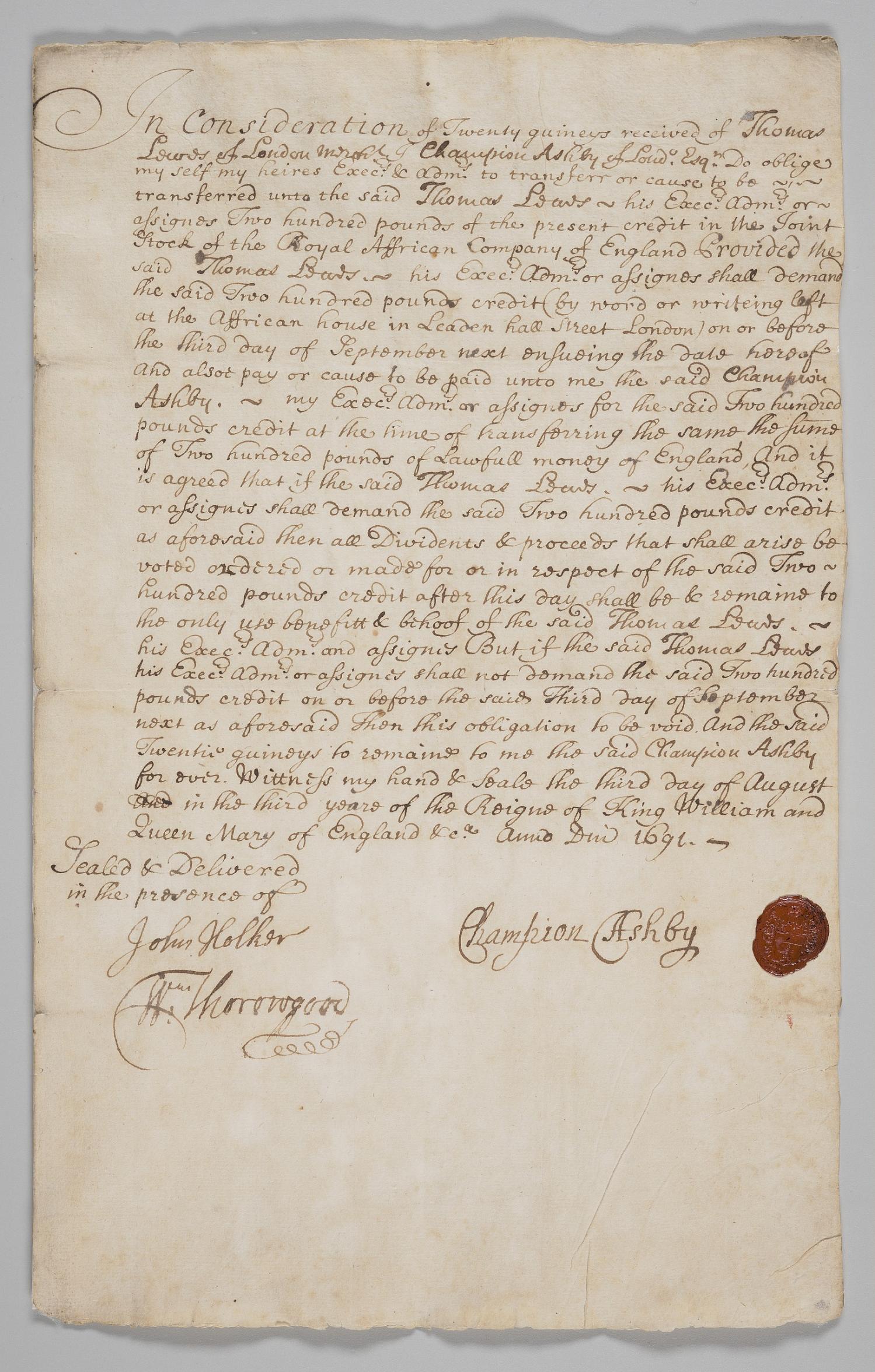
The financial paperwork still survives. The Smithsonian holds a signed 1691 Royal African Company stock-transfer certificate. In it, investor Champion Ashby agreed to arrange the transfer of £200 in company stock to Thomas Louws.
This is what it looked like on paper. Shares in a company trafficking human beings, passed between gentlemen like any other investment, signed, witnessed and sealed.
The company kept ledgers of voyages, sales and expenses, now held at the National Archives in the T 70 collection. Behind each entry were people taken from their homes, shipped across the Atlantic and sold into slavery. [27] [32]
And here’s the thing. Anyone can get a free reader’s ticket at the National Archives at Kew and read those ledgers. The records of the trade are open to all of us. The official pictures of what the Crown took come with conditions.
William III: the shares recorded in black and white
In January 1689, Edward Colston, the Royal African Company’s deputy governor, transferred £1,000 of company shares to William, Prince of Orange, shortly before he became William III.
Yes, that Colston. The same man whose statue protesters pulled down and threw into Bristol harbour in 2020. [33] The slave trader people argued over on the evening news was handing shares to the next King of England.
Historian Brooke Newman found the transaction in the archives. The entry records Colston’s transfer of £1,000 in company shares and William’s acceptance, not a cash payment. The Guardian published an image of the manuscript in April 2023. [34]
The same reporting found that the company reimbursed Colston and that William became its governor. Historic Royal Palaces acknowledges that William personally invested in the Royal African Company, alongside the earlier roles of Charles II and James. [34] [30]
So the record holds a royal charter, royal management of a slave-trading company and a documented royal shareholding. It doesn’t show how much of today’s royal wealth came from these companies, or that any monarch ordered everything they did. It doesn’t need to. Members of the British monarchy held authority and financial interests in businesses that trafficked enslaved people. [35]
The Price of Inherited Power
Across this series I’ve followed the public money paid to the monarchy, the assets attached to the Crown, the income that comes with hereditary titles and the laws around royal wealth. This part followed the records further back: charters that gave companies their privileges, royals who governed and invested in slave-trading businesses, famines under Company and Crown rule, and a diamond taken from a ten-year-old.
These connections are documented. The evidence examined here doesn’t establish how much of the King’s private fortune, if any, can be traced to the slave trade, or whether particular modern royal estates were funded by its profits. That would require a traceable link between historical transactions and assets held today. But you don’t need that to ask if an institution inherits authority and privilege, what responsibility does it have to explain how that authority was used?
The monarchy’s supporters can fairly point to its public duties and its place in national life. Neither removes the institution’s history.
And as I said earlier, the “we” in all this was never all of us. A wealthy investor in slavery and an ordinary British worker were not in the same position, and neither lived through what was done to enslaved Africans. Blurring those experiences hides who held power and who paid for it.
When Britain abolished slavery, who got the money?
In 1833, Parliament authorised £20 million in compensation as part of the law abolishing slavery across most of Britain’s colonies. It went to people with recognised financial interests in enslaved people, including former owners and creditors. There was no equivalent compensation for the people who had been enslaved. [36]
Let’s call it what it was. A bribe. Slave owners were paid to let go of people they had been allowed to own. The people who had been owned got nothing, and most were made to keep working for their former owners, unpaid, as so-called apprentices until 1838. [36]
That was the British state spending public money, not the monarch paying from a personal account. But it went to particular claimants and financial interests, not to the public, and certainly not to the people who had been enslaved. UCL’s Legacies of British Slavery research lets anyone look up who got what. [36]
So the question isn’t only whether anyone will apologise. Who received the money? Why were the people who endured slavery left out? And now that it’s all on the record, are we going to let the institutions that profited walk away a second time, with no account of what they gained? I don’t think we should.
Nobody alive today bears personal responsibility for Britain’s transatlantic slave trade of centuries past, and nobody inherits personal guilt. But an institution that celebrates its continuity, that wears the crowns, keeps the jewels and once dated its documents by the years of its kings’ reigns, doesn’t get to choose which parts of that continuity it owns. It can’t keep the diamond and lose the receipt.
One final document before we follow the money. This is the mark the South Sea Company put in its own records. Look at it properly this time.
The Price of an Apology starts there. Our next investigation follows the £20 million: the people Parliament chose to pay, and the people it chose to leave with nothing.
Coming next: The Price of an Apology. Seven parts. The records behind the reckoning.